|
HorticultureHistory of the Commission’s HorticultureEven before the Imperial War Graves Commission was formally constituted in 1917 attempts were already being made by the Army Graves Registration and Enquiries, with assistance from the Red Cross, to make burial grounds along the Western Front less bleak by growing annual flowers, grass, shrubs and trees in them. In 1916 the Assistant Director of the Royal Botanic Gardens at Kew was asked to visit cemeteries in France and to make recommendations about the plants that should be grown, thus beginning an association that has lasted to the present day.
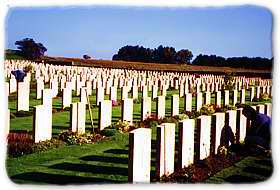
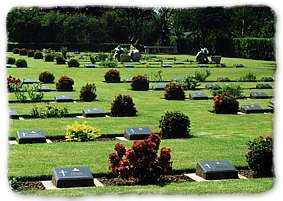
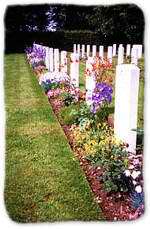
As the pattern for the future maintenance of the cemeteries evolved in the immediate aftermath of the war, horticulture played an important part, and the architects worked together with horticulturists on the overall design of cemeteries. Some of the Commission’s principal architects, in particular Sir Edwin Lutyens, already had considerable experience of the sympathetic combination of structural and horticultural elements: the ideas of Lutyens’ horticultural mentor, Gertrude Jekyll, had a great influence in the cemeteries through the use of cottage garden plants and roses in the headstone borders. The concept was to create a sentimental association between the gardens of home and the foreign fields where the soldiers lie, and the Commission continues this tradition today by planting species native to its member countries in cemeteries wherever possible. Aims of the Commission’s Horticulture WorkThe overall aim behind the horticultural design of a cemetery is to give the effect of a garden rather than the common concept of a cemetery, a place where the harmonious combination of the various elements may help the visitor to achieve a sense of peace in a beautiful and serene setting. The manifest care with which the cemeteries are tended should also bear witness to the fact that the sacrifice of those who lie there is still remembered. Horticulture in Commission CemeteriesEach headstone border is planted with a mixture of herbaceous perennials, alpines and floribunda roses. The plants immediately in front of headstones are low growing so that the engraved personal inscription is not obscured, and they also prevent soil from splashing back onto the headstones during rain. Plants are selected which provide variety in texture, height and timing of floral display. A typical border planting scheme is made up of up to 20 plant species, which is repeated in phases down the row of headstones. The roses planted in a particular row are normally of the same variety as each other but a pattern may be established between rows as different varieties are used and repeated through the cemetery. The flower borders are extended behind certain rows of headstones to break up the effect of line upon line of stone. Low shrubs are planted at the ends of the borders to give definition to the grass avenues between the plots. Lawns are used in cemeteries throughout the world where a sufficient water supply is available. They provide the appropriate setting for the headstone rows, and the absence of paths contributes to the simplicity of design of the cemetery as a whole. Other horticultural features, such as trees, shrubs and hedges, contribute to the architectural form of a cemetery, helping to give interest, shape and coherence to the design, in addition to providing shelter, obscuring unwanted sights and defining boundaries.
This form of horticultural treatment was applied in France and Flanders
after the First World War and in many other places; but in some, such
as Turkey and Greece, the use of pedestal grave markers instead of headstones
made a different kind of flower border necessary. IrrigationWhere insufficient rain falls to allow a lawn to flourish, irrigation is used throughout the dry season. Water in many parts of the world is a precious commodity and its use is carefully monitored to ensure none is wasted. New Developments
Where grass has to survive without irrigation (such as in Gallipoli and some cemeteries in northern Greece) drought tolerant grasses are being experimented with. They also have a greater tolerance to salt, require less fertiliser and grow at half the rate of fescue and bent grasses (the common grasses of lawns). After the Second World War the Commission’s responsibilities increased considerably, particularly in tropical and desert areas where different plants and different styles of planting were used; but wherever possible the Commission continues to use lawn with herbaceous borders. The total ground area within the Commission’s control is about 710 hectares, of which over 450 hectares are under fine horticultural maintenance. Throughout the growing season in northern Europe there is a ceaseless round of mowing, hoeing, edging and dead heading; when growth ceases the equally important winter tasks of cultivating and replanting the headstone borders, relevelling turf and pruning the trees and shrubs take over. The pattern may differ in the tropics but the same careful attention to the craft of gardening is given the world over. |
|||||||||||||||||||
©2000-2002 The Commonwealth War Graves Commission. All Rights Reserved. Legal notices and terms of use | Contact the Webmaster |
||||||||||||||||||||